Monday, January 16, 2023

Bette Shows Marked Improvement/But Has Eye Issue

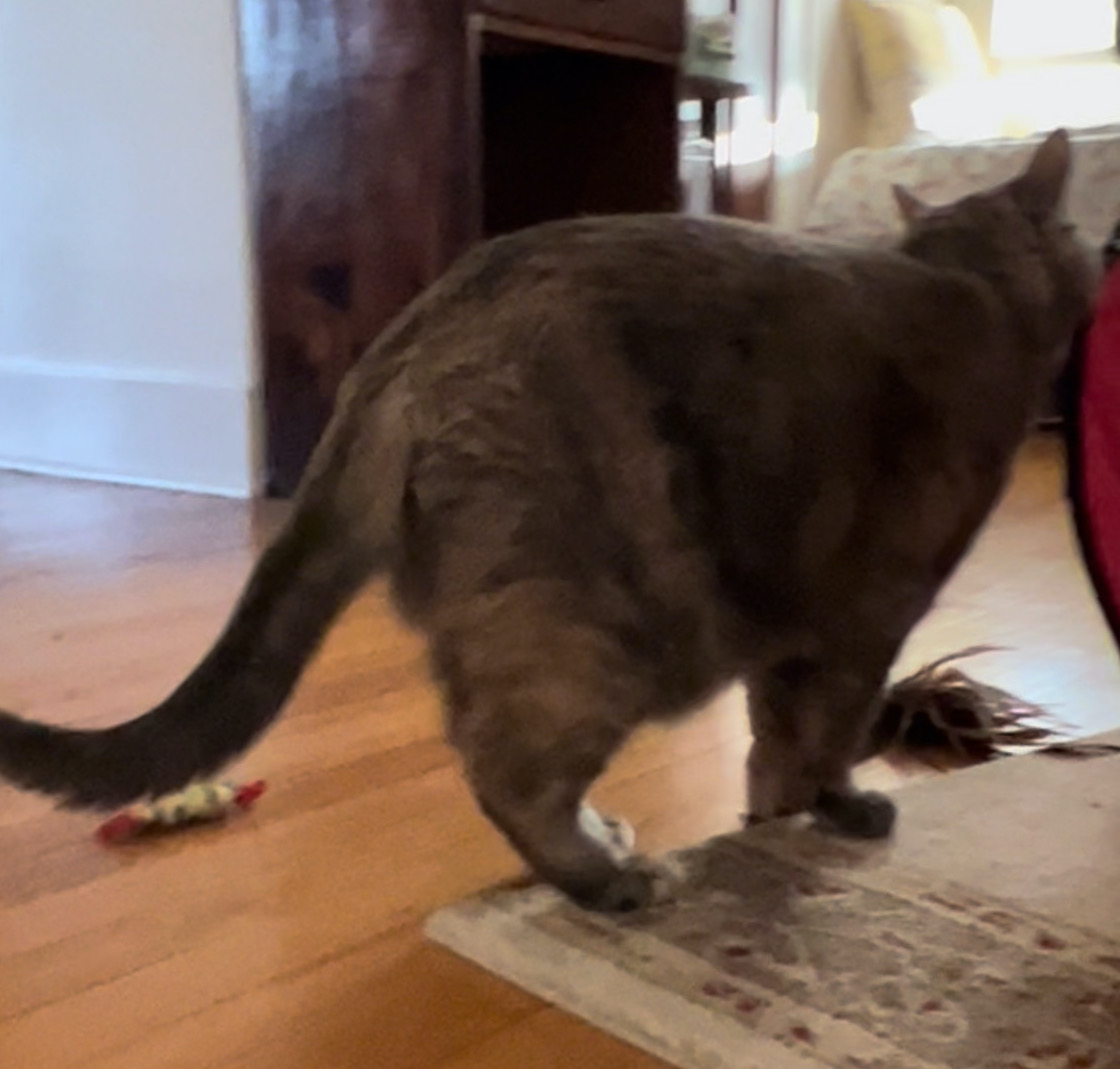
Bette is showing marked improvement. She is eating normally, having full bladder urine release since Saturday, having full solid normal bowel movements since Sunday, is able to walk on paws and not hocks since Saturday, and her tail is going higher each day. Today she flicked it above her spine! See photos.

But since Friday I thought her right eye was sinking-similar to Horner's that Jimmy has had. So I have been giving her Tobramycin in each eye and Quadruple ear cream since Saturday. Today, she looks much better. We will continue with the medication regime.

Bette walks on paws Monday


Saturday, January 14, 2023

Bette Recovering Can Now Lift Tail

Bette-after five days on prednisolone, can lift her tail half way up! That's good news because it shows that the inflammation was likely present and likely the culprit. How it got inflamed is the mystery.  By Wednesday she could move it side to side so it's good to see further improvement. She is finally also releasing a full bladder of urine each time. Is that due to the tail issue improving? The inflammation decreasing?


She is not passing that much fecal material but I don't know if it's an issue still or she is more regular. They are supposed to have a daily bowel movement but I don't think our cats have ever been that regular. 

Wednesday, January 11, 2023

Bette Update-Improving With Steroid; No Heart Issues

Bette saw the cardiologist today who said she is still heart issue/heart disease free and can continue taking prednisolone for the rear leg/spine inflammation. 

Bette has shown marked improvement since taking steroids Monday afternoon-even by Monday night. She is eating better, she has not lost weight-her weight today was 11.13, what it was Friday. She is moving better, still a bit shaky, but trying to use her paws and not her hocks. She tried to jump up on furniture today. Her tail is now moving sideways but not yet going up. She has been slow to empty her bladder. Tuesday she went out of the box a few times and on the pads we had under the box. But this morning, she used the box twice-small amounts. I was concerned that urine retention would lead to a bladder infection/kidney infection which is a serious issue, possibly life threatening. She saw the vet after the cardio and they were going to check her urine but her bladder was small, meaning she has been able to empty it somewhat. The vet hopes that will improve but that Zeniquin-for the infected anal glands-will also prevent/take care of a UTI. 

Then this afternoon, she did TWO large urines. She is still having trouble passing bowel movements despite Miralax. The vet has prescribed a medicine Prucalopride to help the colon muscles contract. She will take a very low dose. We are getting it compounded so that we can titrate the dose as needed.

The vet wants to continue steroids until Bette improves-2 to 4 weeks. We will taper off the steroid as required (the body makes steroid so when it has a steroid medication, it stops making as much as needed. Tapering off allows the body to begin making a level of steroid that it requires.) 

If the condition does not improve or if it returns, or even if she is just fine, she may at some point need an MRI to check the arthritis vertebrae noted on the xray. Dogs often have issues with their vertebrae being compressed, causing muscle/nerve damage and difficulty walking, urinating/bowel movement. Most dogs can successfully have surgery. It's rare for cats to have serious issues that would need surgery, and rarer still for owners to get surgery. I think we would skip it-expense being one, invasive and with a possible low outcome of improvement as another. But an MRI-expensive-would tell us if this is a chronic condition or is a temporary one. 

So for now we continue with meds and monitor progress. The vet wants a progress report Friday and a new xray to check her colon if she is not passing enough fecal matter. 

Monday, January 9, 2023

Bette Has Another Vet Visit Monday-Weak Tail, Possible Weak Ability to Express Urine/Fecal, Inability to Walk Rear Legs

Bette: unable to walk well, unable to fully use back legs, back legs slide underneath her, lethargic, not eating as well as she should, cannot lift her tail, cannot jump or climb, and back legs have lower blood pressure and feel tepid and not warm. Was put on prednisolone. 

After Friday's visit to the vet that revealed numerous issues for Bette Davis, I noticed later that evening that she was walking strangely, wobbling a bit. I thought it was from the expressing of anal glands and fecal matter dug out of her rectum. But on Saturday I realized that she was not lifting nor moving her tail and that her back legs were weak and sliding out from her. Over the weekend they seem to grow tepid to touch unlike her front and unlike the other cats' legs. I almost took her to the ER because I feared it was thrombosis-a clot the heart throws when a cat has heart disease which Bette so far, as far as we know, does not.

I took her back to the vet on Monday January 9, and vet checked the blood pressure of her back legs-only the left because the right is slightly annoying or painful for Bette. The left leg had 80 (over?) bp while the front had normal 120 (over?). But the new xray as the one Friday, showed a normal size heart, clear lungs; the vet didn't hear congestion nor a heart murmur (murmurs are not always present with heart disease but can indicate the presence of heart disease.) So the vet doesn't think it's thrombosis. She watched her walk and was concerned. She said she realized that when they cleaned her out Friday, and drained the anal glands, she did not resist. That indicates that Bette was already numb on her back and back legs. 

Unfortunately, this might also mean she's unable to express fecal matter AND unable to fully urinate. URINE RETENTION can lead to bladder infection which can lead to kidney infection which leads to another vet or ER vet visit. We must monitor her ability to urinate regularly and we may need to learn to express her by squeezing the bladder and forcing out the urine. We are also giving her Methigel to help prevent stones and irritants in the bladder. We will keep her separated as much as possible to monitor output. I secluded her when we returned then let her out for the evening and will seclude her overnight. 

The vet gave her a steroid-prednisolone-to bring down any inflammation in the rear that could be the cause of any pressure on the back nerves. We are hoping that this is the reason for the lameness and that soon her tail will heal. The tip of the tail moves but only the last two inches of her tail responds. She is unable to lift it to use the litter box. 

Bette is eating but small amounts at a time. We need to continue giving Miralax and monitoring to make sure she does not have diarrhea. She needs more water by mouth to help the bladder stay healthy, the body stay hydrated. 

She did try to use the litter box after being home an hour but nothing came out. But she seemed to think something had and covered it in the box but nothing was there when I scooped. But two hours later, she had produced a small urine and bowel movement. 

I called her cardiologist so that we can rule out thrombosis and she will see her Wednesday. 

Sunday, January 8, 2023

Bette Davis Develops New Issues Leg Lameness/Gastro Motility// Update on Cats

I have been remiss in writing the blog. My last post was 2021 although the Facebook page has been updated as things happened. 

We continued to have issues with Jimmy's eyes and ears but instead of Horners (2021) it was in the summer of 2021, 2022 more of an allergy. He took Tobramycin eye drops, and Quadruple Topical Ointment for his ears. His litter box issues come and go. He might not go out of the box for two months then suddenly go against a chair, or on the floor, or counter, etc. We have increased his Prozac to .42. He has been taking that since about 2011. It is compounded into a liquid by a local compounding pharmacy so that we can titrate the medication as needed. The pill is too difficult-impossible really-to cut into small doses. He does not have HCM but he might have a liver issue developing for which we monitor.

Katharine continues to take Mirtazapine for inappetence -not wanting to eat well. She has lost over a pound of weight since late 2021. She had been just over 11 pounds and is now 9.13. We give her 1/8 every four or so days, monitoring her intake, and weighing her weekly. If she takes more than 1/8, she gets hyper and cannot settle down to eat.  Katharine-a sibling of Myrna Loy (our original HCM cat that died in 2015 of HCM)-now has mild HCM and is taking Atenolol. This was discovered in September by the cardiologist that she has been seeing annually since 2010 because she has a murmur AND because she's Myrna's sibling. All the siblings see the cardio before dental cleanings (anesthesia) and have seen her annually since they turned 10 years old because the heart changes as cats age. Katharine will now see the cardio every 6 months or more as needed and we monitor her breathing rate for signs of CHF. Katharine ALSO has seizures since 2018 and had a new serious one January 2022 which required an extra dose of phenobarbital and would have resulted in a trip to the ER had she passed out or not responded to the extra dose (not grand mal-she never has had grand mal. Her seizures include acting spacey, unable to walk.) She did go to the vet the next day to get updated blood work CBC/chem panel, and had her PLI/cobalamine/folate updated, as well as her vitamin D levels checked (all necessary for any cat and especially any ill cat.) Her pheno dose is now 3/4 tab BID (twice a day.) We also do a blood test for her pheno levels and that tells us if the level is sufficient or not. If not, or if too low, we need to increase the dose.

Roxanne, Elizabeth have had minor issues these past two years but nothing significant. No new meds. Neither has HCM. Elizabeth's last gastro ultrasound did detect splenic myelolipoma  a small mass on her spleen that does not yet appear to be intrusive or cancerous. We will monitor.

Bette Davis: Bette has idiopathic cystitis  for which she takes Valium daily to help her relax, to help her bladder relax. She has been taking this since 2010. She still receives 2mg per day, 1/2 tab BID. She also developed in the summer of 2021 and in 2022 an allergic reaction in the eyes similar to Jimmy's but with the skin around the eyes inflamed. She has been on chlorpheniramine from Kroger 1/4 tab once a day since 2021; and takes the same Tobramycin and Quadruple Ointment as needed, mostly during the summer when the infection is worse. We do not know a cause since only these two cats are effected. She also has chronic pancreatitis but the test results this fall, and the gastro scan in December showed it was not active.

BUT then it was. The new issue for Bette began around Christmas or just before. Some cat began to drop small hard fecal matter on the floor near the litter boxes. And Bette began vomiting almost daily, either after her morning meds or after breakfast, or sometimes after dinner. And she was not eating well. I was using Miralax in her food, and trying to get her to eat without using Mirtazapine. Then this past week, after New Year, she began struggling to defecate. I took her to the vet on Wednesday and the outcome was:

-she has active pancreas flareup that was the cause of the vomiting; not eating; not eating led to...

-dehydration which led to...

-kidney stones in the bladder but she is female and will pass them easily, unlike male cats. And dehydration also led to...

-severe constipation, inability to pass bowel movement which led to...

-impacted anal glands and an infected gland and both had to be expressed. And now she's taking Zenequin antibiotic which led to.

An xray also showed she has rear spine arthritis, a vertebrae is swollen. Not uncommon in older cats but she is the only with it so far. She may need a pain med in the future. Currently we are to monitor her and not let her jump around. She's not able to jump up-something I noticed around Christmas. 

She is to take Cerenia daily, Zenequin, and her Valium and allergy med daily; we are giving Miralax in water by mouth with a 3ml plastic syringe (I give 9ml at a time, 3 times a day.) And we add Miralax to her food but she still isn't eating enough. We are giving her Methigel too. She still has trouble defecating and the fecal matter has been getting stuck in her rectum and we must pull it out. She did have a normal BM this morning without assistance. To help her pass things, we will give her Laxatone. 

BUT then today-Sunday 1/8/23-she developed rear leg weakness. Her paws are warm-not cold which would indicate a blood clot but I will monitor. I will call the vet Monday. She is not able to raise her tail either, which we thought was part of the anal gland issue and might be. But it could indicate more serious nerve damage. It could heal in time or lead to inability to control her urine/defecation. All of this is quite sudden. As far as we know, she had no accidents in the house, hadn't fallen, was doing well until after Christmas.

Wednesday, March 3, 2021

Because My Cat's Can't Have Normal Issues-Now Horner's Syndrome Appears

Jimmy Stewart has seemed to have issues lately with his left eye. I began to notice that it seemed to be sinking or receding and not as out there as the right eye. Then Monday he presented with both eyes being watery and runny and he was squinting. He went to the vet Tuesday and there are no ulcers, scratches, and his eye pressure-checked for glaucoma-was normal. The vet said the eye is receding, the pupils do not match, and the furry skin around it is beginning to droop over it. She thinks this might be due to Horner's Syndrome an issue that has many causes but presents with the symptoms of receding eye, droopy lids, constricted pupils; can also lead to color changes in the ears, increased warmth feeling of the ears. 

These are caused by damage to the nervous system that controls the head, the SYMPATHETIC nervous system. There are two branches or trunks of nerves-sympathetic and parasympathetic. They push/pull the eyes and eyelids. The path of the nerves travels from the brain along the spine to the back of the body. Any damage to the body along the way, or in the brain, or in the head, ears or eyes, can damage the sympathetic nerves. This damage can be caused by tumors, cancer, diseases, even physical injury in the legs or hitting the head against something. For dogs, pulling on a collar when being walked on a leash can damage the area around the neck. 

You must treat the underlying cause of Horner's Syndrome if one can be found. Most causes or problems will clear up without intervention depending on cause, and the eyes will improve. If symptoms get worse or doesn't respond to treatment, an MRI or ultrasound may be next to look further into the body. 

The vet thinks Jimmy might have an ear infection because of his reaction to having his ears checked. She gave us an antibiotic ear cream to use for ten days. If the infection clears up, his eyes should improve. If the eyes do not, then maybe the MRI or try a new medication. It's one of those confounding "keep an eye on it" (no pun) and hope for the best. 

But of course my cats can't have something normal. How often does one hear or read about Horner's Syndrome? 

Here's an article the vet game me to read:

https://veterinarypartner.vin.com/default.aspx?pid=19239&id=4951369

Sunday, February 7, 2021

Baby's Necropsy Report-Death Caused By Acute Pancreatitis Attack

Baby's necropsy report shows she died of complications from an acute pancreatitis episode. She did NOT HAVE TRUE HEART DISEASE although she had mild changes to her heart due to age. Her liver had signs of decrease function due to the overall decline in her body function. The kidneys were STABLE despite CKD, and she was not in end stage CKD. She DID NOT HAVE CANCER. We finally got a copy of her initial test results-the reason she had the biopsy in the first place-and she did NOT have lymphoma. She did NOT die of any of her known illnesses. She did NOT have any complications from her known illnesses that led to her demise. (Except pancreatitis which was diagnosed as IBD even in January.) She did NOT have any clots in her legs and no skeletal signs of damage so the pathologist does not know why she was lame unless it was due to severe dehydration that caused weakness. 

Pancreatitis can kill our pets? Yes, and humans. A severe flareup can lead to shock, blood loss, enzymes released basically can eat away at the fat in the pancreas causing severe damage; as the body shuts down, all other organs are affected. This is why keeping track of pets' vomiting and diarrhea, getting a PLI blood test, keeping up the weight by eating on a consistent basis (normal weight), and giving necessary medications (antibiotics for example) is key to avoiding or decreasing pancreatic or even IBD flareups in order to maintain a healthy GI tract, and avoid deadly acute attacks. Here's one study that showed many of the same signs that were exhibited in Baby:

 "...Dehydration (127/157 cats; 84.7%), lethargy (114/157; 72.6%), and anorexia (97/157; 61.8%) were commonly observed. Other signs, in decreasing order of frequency included vomiting, owner‐reported weight loss, hypothermia, tachypnea, icterus, inappetence, abdominal pain, diarrhea, and fever (rectal temperature, >39.5°C; Table 1). Lethargy was more frequent (P = .003) in nonsurvivors compared to survivors. Fever (P = .042) and weight loss (P = .034) )...Putative etiologies of pancreatitis (21 cats; 13.4%) included recent general anesthesia (10 cats; 6.4%), trauma (6; 3.8%), hemodynamic compromise secondary to heart failure, urinary obstruction or gastrointestinal foreign body (4; 2.5%), and organophosphate intoxication (1)...weight loss was negatively associated with outcome.32 Lower BCS at presentation and occurrence of weight loss are frequent findings in FP,11, 13, 24, 28 possibly representing a protracted disease course...Duration of clinical signs before presentation plays a role in development of a negative energy balance, and results of the multivariable logistic regression analysis suggest the longer the duration, the higher the risk of death...increased frequency of azotemia in nonsurvivors, which previously has been associated with hypothermia in cats...withholding food is no longer recommended, and PN alone has been shown to compromise intestinal barrier integrity, increasing the risk of bacterial translocation and promoting mucosal atrophy and proinflammatory responses...failure to eat voluntarily during hospitalization was a significant risk factor for death...intrahepatic bacteria were noted in 41% of cats with inflammatory liver disease,59 which is clinically relevant, because hepatic and pancreatic inflammations are common comorbidities in cats, because their collecting ducts join anatomically before entering the duodenum..."

Something happened at the vet hospital to cause pancreatitis, and then they ignored her decline and that she was weak when they released her. They continue to say that she was too sick and that's why she declined (I want to point out that their initial exam said she was 8/9 body condition, and that the ultrasound found nothing seriously wrong.) It's their way of ignoring what they failed to do-to follow proper protocol, if they have any-to keep track of all patients' conditions at all times. They also excuse themselves by saying that I told them she often doesn't like to eat when away from home-which is true. BUT how does that absolve them of all medical care and responsibility for her care and condition? It does not. She got an acute attack of pancreatitis which they triggered, ignored, didn't notice and therefore, didn't treat nor did they alert me to her condition. 

I spoke to the pathologist and here is the explanation from the report listed below: 

Her body declined because it was not able to compensate for all that was happening due to the acute attack of pancreatitis. She was possibly going into DIC-"...can lead to massive bleeding in other places." Many illnesses or issues can lead to DIC and pancreatitis can cause DIC. She would have needed blood transfusions (which the ER tried to find for her-they tried to find a donor-and couldn't; it turned out a local vet hospital near us actually carries blood.I didn't find out until after she died. The pathologist said she would have likely needed more than one and that she may have been too far gone for it to work.) She was leaking internally as she declined, leading to organ failure and some fluid in the abdomen cavity and the lungs and pericardial sac: "whole body tricavitary effusion". The thickened heart seen grossly was not apparent histologically, meaning she did not have HCM nor any heart disease. She had necrosis of the pancreas abdomen fat because the pancreatic enzymes eat the fat, break it down, damaging the pancreas further. The body's systemic response to pancreatitis, can lead to shock which she may have been or had begun to experience. The duodenum can release bacteria into the pancreas and that could have caused the early onset of inflammation. Fluids, pain meds and a feeding tube are the only and best methods for support and treatment for pancreatitis. But Baby wasn't responding. She had mild heart changes due to age or CKD but did not have HCM. She had liver changes due to either the heart, or as her body failed, or if she had been hypotensive for too long, or if she her body lacked oxygen to the liver. The pulmonary edema was not CHF or heart failure. Could have been from fluid therapy that the body couldn't handle as it declined, leading to the "tricavitary effusion".

From the actual necropsy report:

"...

Microscopic Description

Representative routinely stained sections of brain, heart, lung, trachea, kidney, liver, spleen, adrenal gland, thyroid, pancreas, stomach, small and large intestine are examined. Autolysis (destruction) was at least mild in all tissues and moderate in sections of intestine.

In sections of pancreas, there is regionally extensive necrosis of pancreatic acini (dead cells of digestive enzymes.)  There are low numbers of inflammatory cells infiltrating the supporting stroma between acini, primarily neutrophils, lymphocytes, and plasma cells. The supporting stroma is moderately expanded by edema. Within the pancreas, there are multifocal expansile nodules composed of proliferative pancreatic acini. Peripancreatic fat is infiltrated by large numbers of variably degenerate neutrophils. Extensive regions of peripancreatic and mesenteric adipose are replaced by pools of variably mineralized necrotic material and degenerate inflammatory cells (fat cells were dying and they release calcium.)

In the sections of left ventricle, there are occasional regions where there is variation in myofiber size, with a small number of cardiomyocytes appearing shrunken, with loss of cross striations and pyknotic nuclei. The interstitium in these regions is expanded by variably loose fibrous connective tissue. In sections of liver, there is moderate to severe centrilobular hepatic cord atrophy and sinusoidal congestion. Central veins are often dilated. In both kidneys, there are aggregates of lymphocytes and plasma cells infiltrating the interstitium. The interstitium is multifocally replaced by fibrous connective tissue. A small portion of glomeruli are shrunken and sclerotic. All other examined tissues are histologically unremarkable.

Morphologic Diagnosis(es)

Pancreas: Severe acute necrotizing pancreatitis, steatitis and saponification of fat; Exocrine nodular hyperplasia Heart, left myocardium: Mild multifocal interstitial fibrosis and cardiomyocyte degeneration
Liver: Centrilobular congestion and hepatic cord atrophy
Kidney: Moderate multifocal lymphoplasmacytic interstitial nephritis, fibrosis and occasional glomerulosclerosis

Final Diagnosis(es)

1. Severe acute necrotizing pancreatitis, steatitis, and saponification of fat
2. Mild degenerative heart disease and secondary hepatic chronic passive congestion  
3. Chronic kidney disease

Comments

The most significant findings histologically was the severe necrotizing pancreatitis. The most common cause for necrotizing pancreatitis in cats is ascending bacteria from the duodenum. While no bacteria were observed in the examined sections, once the pancreas becomes inflamed, release of digestive enzymes can drastically exacerbate the condition. The changes in the heart were overall mild, however, there was evidence of decreased cardiac function in the liver (chronic passive congestion). The findings in both kidney are supportive of chronic kidney disease. The There was no evidence of a neoplastic process in any of the examined tissues.

..."


Baby as a kitten at 5 months.