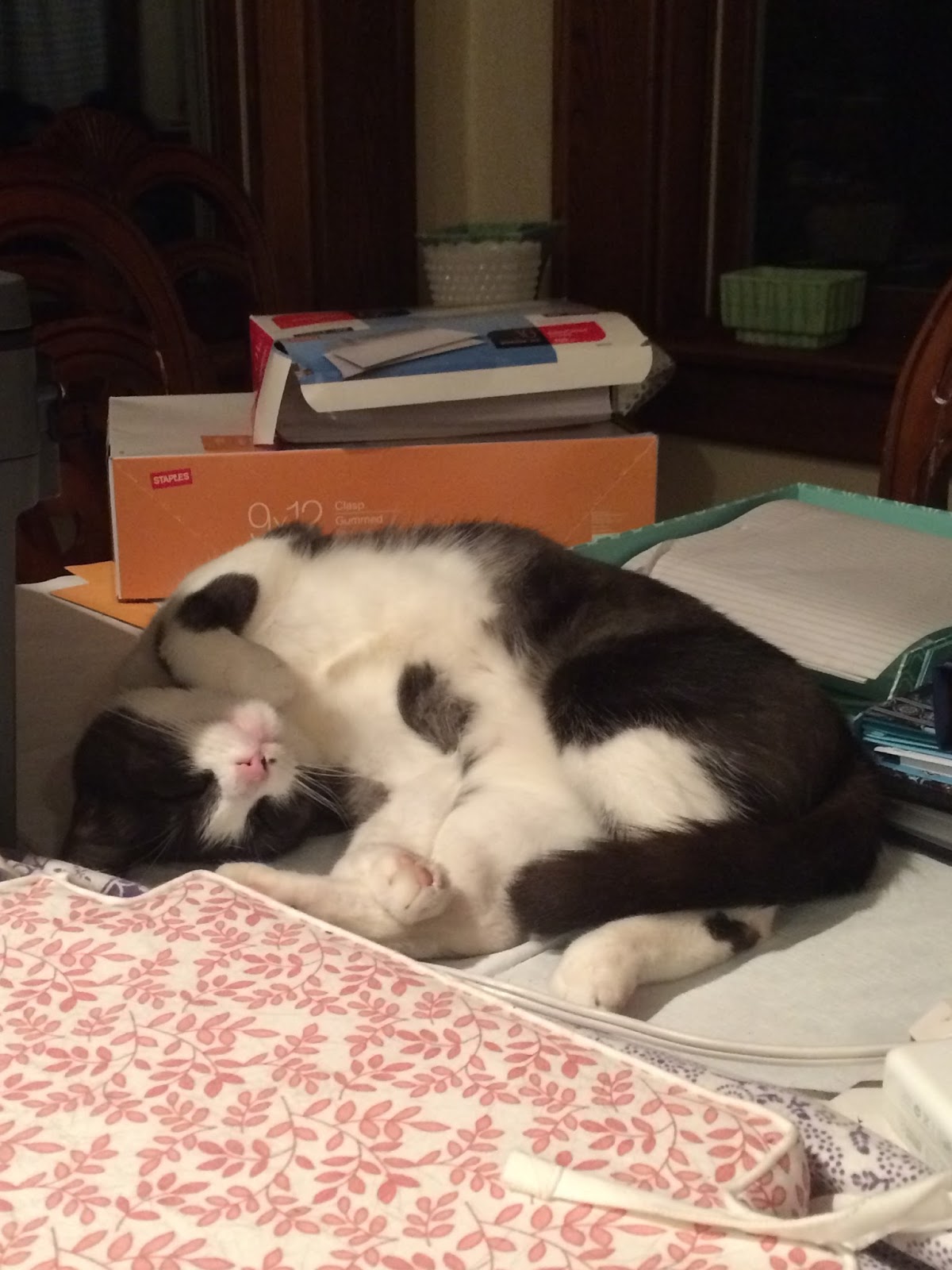
A neighborhood cat showed up in our yard back in May, suddenly, and acting frantic. It would cry and try to paw at the window and door, and seemed in a panic. We began feeding it and petting it outdoors but wouldn't let it in. It had a collar. Surely it had a home, we thought. But each time we saw it very late at night and very early in the morning in our yard, we began to wonder if it had a home.
I posted photos to the neighborhood Facebook page and eventually received replies from neighbors who either loved the cat and fed it, allowed it inside, and found it also was frantically pawing at their doors for attention; or hated to have it in their yard, cornering their cats-and dogs. One neighbor went so far as to allow children and dogs to chase it. Eventually, someone knew the owner who lived two streets over. I left her a note and a few days later she called me.
Yes, the cat is hers. Yes, she sees it every day. Yes it's fed. Yes, it has its shots. But it likes to be an outdoor cat and cries incessantly to go out. So, she allows it to come in and out through her window with a broken screen.
We noticed that Rox liked to lay under our bushes. She would lay under the deck. But she also slept there at night. We began to think that she wasn't going home.
Then she disappeared for a week. And during that week, I was outside a lot even at night. No sign of little girl. Then suddenly she appeared in early July, frantic for food and attention again. She kept coming around all day, then would disappear for hours. Sometimes she was sleeping under bushes or the deck; sometimes she was at the neighbors and would come running over when she heard me open the back door or call her name. I would feed her food on the deck; we put out fresh water on the deck; and we put a litter box on the deck which she began using. We began picking her up and petting her because I feared she would become too feral. We began playing with her. She would hang around for awhile then take off, sometimes over the fence into other yards, other paths, following her own schedule. But during all of July, she kept coming back more often, and then hanging out in the yard more often, and sleeping on the deck when not too hot. When it rained one day, I brought her inside. We set up a litter box in the back room and gave her food and water. (We had to give up on the outdoor litter box because the raccoons discovered it and they were scattering litter all over the deck, as if it were a sand box toy for them.)
Since then, she's been mostly living here. We let her set her schedule and cater to her demands for coming in or going out. Because I'm home during the day, she has grown comfortable with sticking mostly in the yard, on the deck or under it and under bushes, even still visiting neighbors; and knows she can mostly come and go as she wants. Gradually, she and we have grown accustomed to letting her sleep at night in the house in that back room.
What I've discovered: originally, I tried to put her in the guest bedroom with me (I didn't want her to sleep alone and she couldn't sleep in our room with our other cats.) Her alarm clock goes off at 3 a.m.; and if she's not out by 5:30 a.m. when the sun comes up, she tries to break down the doors, windows, and makes as much noise to wake the dead in order to be let out. But if we leave her in the back room, as far as I know, she's quiet until we come down stairs in the morning. She isn't destructive, nothing is broken or messed with as if to indicate that she's in a panic about being alone. Then we let her out about 7-8 a.m. after she eats, and she's happy. She likes to come back about a half hour later to eat more, then leave; she comes back again an hour later to check in and then says goodbye and takes off. She will then return 2-6 hours later. If she comes in, she usually sleeps 4-6 hours. If she's not out by 7 p.m., then we can't get her back in before midnight. But if she's out by 7 p.m., she will come back inside on her own around 10 p.m. or so and stay the night. At first, she would cry to go out if I was still up at 1 a.m.; or she would cry to leave if I put her in the guest room So, I've learned to let her think it's bedtime and I leave her by herself in the back room, and she's fine alone.
She's using the litter box inside fine so far. Initially, she was also crying to go out to go and I had to work with her to train her to use the box. We mixed Cat Attract and Wheat litters and that made it easier for her.
We began playing with her using feather toys and cat nip toys, and mice toys. I noticed that she loved to play and loved the attention but doesn't like being held or petted much. What she really, really enjoys is finding the stack of cat toys and the basket of cat toys in our living room. It must be like a candy store. She chases, rolls, bats, etc. and all on her own, although we are in the room and interact on occasion (never interrupt a cat that is playing on its own. It's having fun. It will let you know when it needs you.)
I had to give her a washcloth bath the other day because she was so dirty, the white was grey. But she withstood it. I also clip her nails and she allows it. She won't let me see her teeth, yet.
I'm in contact with the owner. If she wants to keep her at home, she knows how to reach me. But so far, she seems unconcerned. Turns out the owner went on vacation for three weeks in July and left her in the care of roommates who may or may not have let it get back inside. Frankly, if the cat doesn't feel secure at home, it won't return. And if the owner wanted her to feel secure, she'd be more proactive. If we don't take care of the cat, the neighbors will chase her off or she could get hurt. She could still get hurt but she's wary around cars and careful around outdoor wildlife.
One night, we heard a cat screaming and rushed out but we found Rox next to the deck while a poor cat screamed in the distance. (Cat fight or raccoons?) Twice this week, a pair of skunks living nearby have come into our yard while she was hanging out back. She sat up, noticed where they were going, then once they were gone, went back to sleep. I was wide eyed on the porch afraid they might attack. (Would they? Would she?) There was a ground hog hanging out in the yard that she kept going after. It's now gone. (Coincidence? I don't see how she could fend off or scare off a ground hog.)
As for our cats, she spent weeks growling at them through the glass panes of our interior doors and now she ignores them. They watch each other quietly. We do not let them mingle or share things.
So, this is Roxanne, about 2-3 years old, female, spayed, and supposedly up to date on shots. We gave her Revolution for August with the consent of owner. We take one day at a time with her. We let her set her schedule but try to get her in if it will storm or at night or if we will be gone hours.
She's small like Myrna and I find myself worrying and watching over her just like Myrna. But I don't want her to be exactly like Myrna. Please, no deadly diseases. She's not vocal unless she wants something. But she is very sweet.
What can I say? She needs us to be here for her when she needs us. I can't turn her away. If I hadn't found the owner, I would have taken her to our local shelter (a lovely, no kill shelter.) If I don't let her in, she will bother the neighbors who don't like her and wander all over finding someone to help her. So, here she is welcomed for as long as she wishes.
 |
| Roxanne |